
Key takeaways
A convertible loan agreement sets out that an investor lends money to your startup, which is later converted into shares instead of being repaid.
The key terms are the amount, interest, term, the next financing round, the discount and the cap.
The GESSI standard is a published template that startups and investors developed together for German companies.
With our convertible loan generator, you create the agreement in about five minutes, for free and without an account.
The real costs come later, at conversion: that step always requires a notary.
An investor wants to give you money as a convertible loan, and now you need the contract for it. A law firm costs time and fees, and a template from the internet still has to be filled in by you. On top of that come terms like cap, discount or forced conversion that hardly anyone knows the first time round.
What is a convertible loan agreement?
A convertible loan agreement (Wandeldarlehensvertrag) is a contract between a startup and an investor. The investor lends the startup money. Instead of repaying it, the startup later converts the loan into shares, usually in the next financing round. The agreement sets out when that happens and at what price.
The advantage: you don’t have to agree on an exact value for your startup when you sign. You only set an upper limit and a fallback value in case the next round doesn’t happen. The actual valuation is only set in the next round. How a convertible loan works and what it costs in the end is explained in detail in our article on convertible loans.
What goes into a convertible loan agreement
The agreement covers the money, the term, the conversion and what happens if things turn out differently than planned. The example values are chosen for illustration.
Term | What it covers | Example |
|---|---|---|
Investment amount | how much this investor lends | €100,000 |
Total amount of the round | the maximum your startup wants to raise through convertible loans in this round | €500,000 |
Interest | what the loan costs per year; interest isn’t paid out but converted into shares as well | 5% per year |
Maturity date | end of the term; if there was no qualified round by then, the loan converts at a pre-agreed valuation | in two years |
Qualified financing round | the round in which the loan converts: by a deadline, with a minimum amount of new money, part of it from new investors | €1m within one year, of which €500,000 from new investors |
Discount | a reduction on the valuation of the next round, so the investor pays less per share than the new investors | 20% |
Cap | the maximum valuation for the conversion, even if the round is valued higher | €5m |
Forced conversion valuation | a fixed valuation if no qualified round happens by the maturity date | €4m |
Exit premium | if your startup is sold before the conversion, the investor gets their money back with interest, plus this surcharge | 20% |
Subordination | the investor may only demand repayment if it doesn’t push your startup into financial distress; in an insolvency, they only get something once all other creditors are paid | a fixed part of the GESSI agreement |
Of discount and cap, the lower value always applies; they aren’t added together. An example: the next round values your startup at €8 million before the new investors come in. With a 20% discount, the investor would convert at a valuation of €6.4 million. The €5 million cap is lower, so it applies: the investor gets their shares as cheaply as if your startup were worth only €5 million.
The GESSI standard: a template instead of a custom contract
The GESSI standard is a template for convertible loans under German law that representatives of startups, business angels and VC funds worked on. It is published by the German Standards Setting Institute (GESSI), founded in 2018 by the German Business Angels Network (BAND) and the German Startups Association.
A standard has two advantages for you. Many investors already know the template, so you mainly negotiate the numbers. And for every term there are usage notes that explain what it means.
How to create a convertible loan agreement step by step
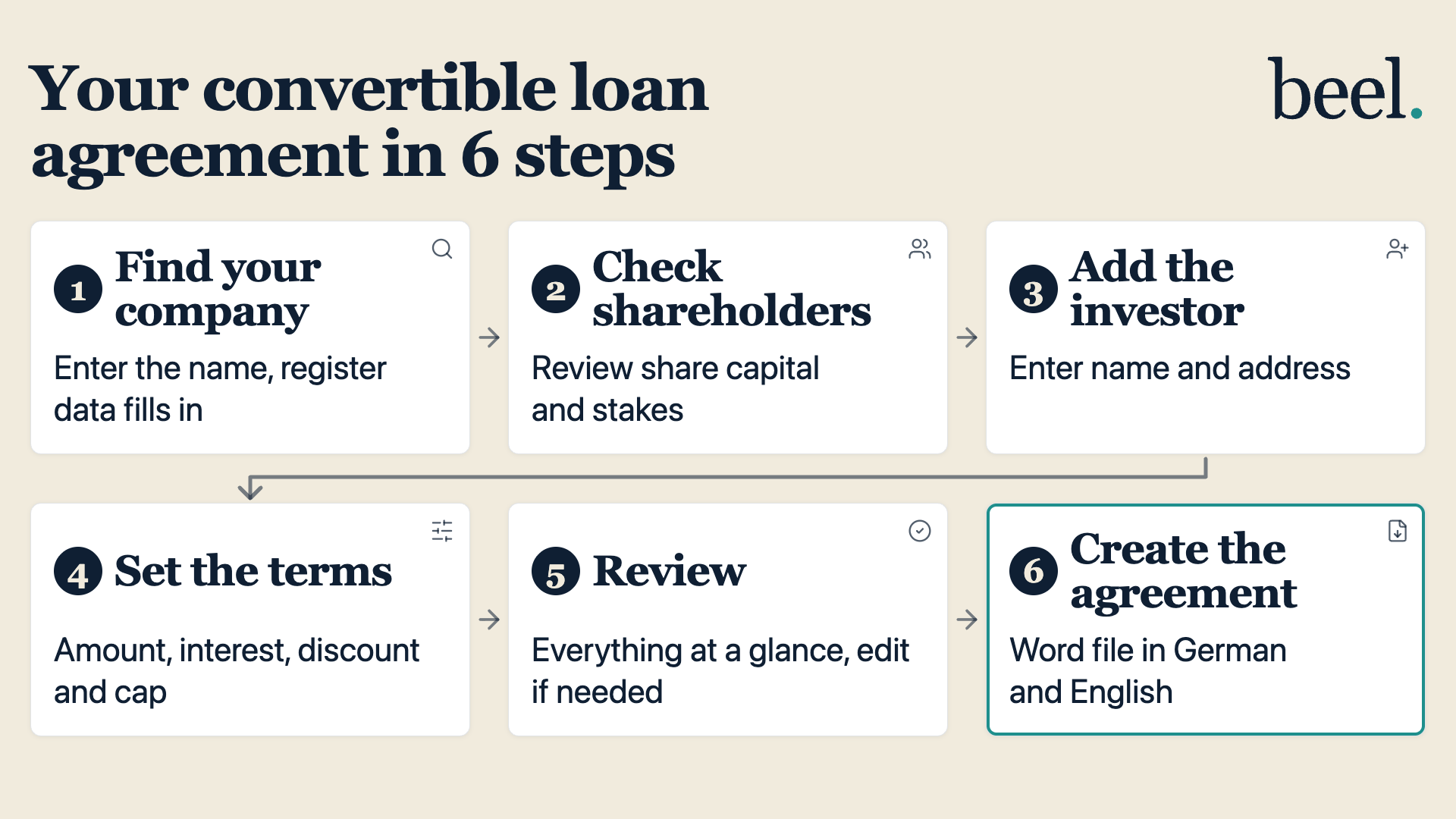 Our convertible loan generator fills in the GESSI template in six steps. It takes about five minutes, is free and needs no account.
Find your company. Enter your startup’s name. The tool finds it in the German commercial register (Handelsregister) and takes over the legal form, register court, register number and address. It works for a GmbH or UG (German limited liability companies) based in Germany.
Check the shareholders. The share capital, meaning the capital registered for your company in the commercial register, and the shareholders with their shares also come from the commercial register. You only check them, and the tool calculates each stake in percent.
Add the investor. Enter the investor’s name and address, whether a private individual or a company.
Set the terms. This is where the items from the table above go: amount, interest, maturity, qualified financing round, discount, cap, forced conversion and exit premium. If you’re unsure about a term, a link takes you to the GESSI usage notes.
Review your details. You see all entries at a glance and can edit each block again.
Create the agreement. You enter your name, email address and phone number. You then download the agreement, and it is also sent to you by email.
If you have several investors, each one gets their own agreement. With “Create another agreement” you start again and re-enter the details.
What you get at the end
You get the agreement as a Word file in German and English. The German version is binding; the English one is a translation. It comes with a ZIP file containing the GESSI accompanying documents:
the usage notes, which explain every term
a shareholder resolution (Gesellschafterbeschluss), in which the shareholders authorise management to take out convertible loans up to a maximum amount and within a deadline
the conversion undertaking (Wandlungsverpflichtung), in which the shareholders agree to approve a capital increase for the conversion and the investors agree to take up the new shares
Unlike the agreement, these accompanying documents are the blank GESSI templates. You fill in the details yourself.
In the agreement itself, two details are deliberately left out: your startup’s bank details and the serial numbers of the shares listed in the shareholder list at the commercial register. The tool doesn’t ask for them for data protection reasons. They are marked with ●, and you fill them in before signing. The agreement also contains a paragraph in square brackets about a shareholders’ agreement: if you have one, add it there, otherwise delete the paragraph.
Before signing: notary and shareholder resolution
The GESSI documents are signed in a fixed order:
Shareholder resolution: All shareholders sign it, and electronic signatures are possible. This makes sure management is authorised to take out the convertible loans.
Convertible loan agreements: Your startup signs a separate agreement with each investor.
Conversion undertaking: Once all agreements are in place, all shareholders, the startup and all investors sign it. Only then do the investors have an enforceable right to the conversion.
Whether the agreement itself has to go before a notary is disputed. In 2022, the Higher Regional Court of Zweibrücken held invalid an agreement that was concluded without a notary and obliged the investor to convert. The GESSI agreement contains such an obligation to convert as well. The ruling is final. Much of the German legal literature disagrees, and the Federal Court of Justice has left the fundamental question open.
GESSI therefore recommends in its usage notes having the agreement and the conversion undertaking notarised (notarielle Beurkundung). In practice, many skip this and knowingly accept the risk. But if the agreement is invalid, the subordination falls away too: the loan then counts fully as a liability again. On paper, your startup may then have more debts than assets, and in the worst case management has to file for insolvency. So decide before signing whether you go to a notary, if in doubt with a law firm.
What is certain: the conversion itself requires a notary, because your startup issues new shares through a capital increase. That is a shareholder resolution passed before a notary.
What comes later: the conversion
With our generator, the agreement is set up quickly. The real costs come later: the conversion needs a capital increase before a notary, an entry in the commercial register and often legal advice. Which costs these are and what to expect is covered in our article on convertible loans.
Conclusion
The agreement sets out the amount, interest and term, and the conditions under which the loan is later converted into shares. With the GESSI standard you don’t have to reinvent it, and with our generator it’s filled in within about five minutes. Before signing, you add the bank details and share numbers and have all shareholders sign the shareholder resolution. Whether the agreement itself needs a notary is disputed, and GESSI recommends it. For the conversion, you need a notary in any case.
Create your convertible loan agreement for free
With our convertible loan generator, you create your agreement based on the GESSI standard in about five minutes. Your startup’s data comes straight from the commercial register, and at the end you get a Word file in German and English plus the GESSI accompanying documents. The tool is free, and you don’t need an account.
Frequently asked questions
Welche Anbieter stellen geprüftes Standardvertragswerk für Angel-Investments in Deutschland bereit?
Für Wandeldarlehen veröffentlicht das German Standards Setting Institute (GESSI) ein Standardmuster, an dem Startups und Investoren gemeinsam gearbeitet haben. Mit dem Wandeldarlehen-Generator von beel füllst du dieses Muster kostenlos aus. Wer seine Investoren ohne Wandeldarlehen beteiligen will, bekommt bei beel rechtlich geprüfte Standardvorlagen für Eigenkapital-Genussrechte.
Was brauche ich als Gründer, um eine Angel-Runde ohne Anwalt und Notar sauber abzuwickeln?
Mit einem Wandeldarlehen geht das nur zum Teil. Den Vertrag kannst du mit einem Standardmuster wie dem GESSI-Standard ohne Anwalt aufsetzen. Bei der Wandlung brauchst du aber einen Notar, und ob schon der Vertrag zum Notar muss, ist umstritten; GESSI empfiehlt es. Ganz ohne Notar kommen Beteiligungsformen aus, bei denen deine Investoren keine Gesellschafter werden, etwa Eigenkapital-Genussrechte.
Muss ein Wandeldarlehensvertrag notariell beurkundet werden?
Das ist umstritten. Das Oberlandesgericht Zweibrücken hat 2022 einen Wandeldarlehensvertrag mit Wandlungspflicht, der ohne Notar geschlossen wurde, für unwirksam gehalten. Ein großer Teil der Fachliteratur widerspricht, und der Bundesgerichtshof hat die Grundsatzfrage offengelassen. GESSI empfiehlt, Vertrag und Wandlungsverpflichtung beurkunden zu lassen, um größtmögliche Rechtssicherheit zu haben. Bei der Wandlung selbst ist ein Notar in jedem Fall nötig.
Was kostet ein Wandeldarlehensvertrag?
Mit unserem Generator kostet das Erstellen nichts, eine Kanzlei berechnet für den Entwurf ihr Honorar. Lasst ihr den Vertrag wie von GESSI empfohlen beurkunden, kommen schon beim Abschluss Notarkosten dazu, die laut Vertrag dein Startup trägt. Teurer wird es bei der Wandlung, wenn Notar, Handelsregister und Beratung für die Kapitalerhöhung dazukommen. Die Kosten im Einzelnen stehen in unserem Artikel zum Wandeldarlehen.
Brauche ich für jeden Investor einen eigenen Vertrag?
Ja, jeder Investor bekommt einen eigenen Wandeldarlehensvertrag. In allen Verträgen steht derselbe Höchstbetrag der Runde, damit klar ist, wie viel Geld höchstens über Wandeldarlehen kommt. Gibst du später einem weiteren Investor ein Wandeldarlehen zu besseren Bedingungen, können die früheren Investoren laut GESSI-Vertrag dieselben Bedingungen verlangen.
Was ist eine qualifizierte Finanzierungsrunde?
Eine qualifizierte Finanzierungsrunde ist die Finanzierungsrunde, in der das Wandeldarlehen in Geschäftsanteile umgewandelt wird. Sie muss bis zu einer Frist stattfinden und einen Mindestbetrag an neuem Geld bringen, ein Teil davon von neuen Investoren. Kommt sie nicht rechtzeitig, wird zum Fälligkeitsdatum zu einer vorher festgelegten Bewertung gewandelt, der sogenannten Zwangswandlung.