)
Key takeaways
Without your own network, the way into startups runs through an experienced business angel who shares their deals with you. You decide on every deal yourself.
The bottleneck is often not money, but access to funding rounds.
If you want to invest in startups over the long term, you need many holdings, and that means access to many deals.
A syndicate opens up that access: no fund, no company in between, no obligation to invest.
Who you follow is the most important decision, not where you invest.
The problem is not money, it is access. Many private investors across Europe would like to invest in startups and still don't. They can't get into the funding rounds, or the route there seems too complicated.
Capital is not what is missing. In Germany alone, private households held around 3.6 trillion euros in cash and bank deposits at the end of March 2026. That is more than a third of their total financial assets of around 9.5 trillion euros (Deutsche Bundesbank).
But you can't invest in a startup the way you buy a share on the stock exchange. Startups are not listed, anywhere in Europe. To invest, you need a place in a funding round. In startup jargon, such a place is called a deal: the concrete opportunity to invest in one particular startup.
This article explains why these places are so hard to get, how experienced business angels invest, and how a syndicate gives you access.
Why it is so hard to invest in startups
Investing in startups is hard for private investors mainly because startups choose their investors themselves. A place in a funding round is not sold, it is allocated.
A funding round is when a startup raises money from investors, who receive a stake in return. Founders want more than money: they want investors who bring experience and contacts. Sought-after rounds are therefore often full before anyone outside the network hears about them.
There is also a practical reason. In a German GmbH, every new shareholder means notarised declarations, an updated shareholder list at the commercial register, and more coordination on later decisions. So founders prefer a few larger investors to many small ones. Our worked example on the convertible loan, a loan that later converts into equity, shows how expensive many small shareholders become.
The result: access runs through personal contacts. If you are looking to invest in startups and don't know anyone in the scene, you often only hear about a round once it has closed.
The classic routes, and why many people end up not investing at all
How do you invest in startups if you don't know anyone in the scene? Without a network, there are traditionally two routes. Both come with high hurdles.
Directly as a business angel. A business angel is a private person who puts their own money into young companies and often supports them with experience. For that, you need exactly the contacts you lack. The startup has to want you as an investor. And in Germany, every investment runs through a capital increase in front of a notary, in which the startup issues new shares.
Through a venture capital fund. A VC fund pools money from many investors and invests it in startups. Many of these funds have legal minimums. For European venture capital funds (EuVECA), private investors must commit at least 100,000 euros. For German special funds, it is at least 200,000 euros, each with further requirements. Your money is then typically tied up for around ten years. And you don't decide which startups the fund invests in.
For many, the idea ends where it started: they don't invest at all.
Portfolio, not a single bet: how angel investments work
 Experienced business angels spread their money across many startups rather than one. They expect a large share of their holdings to fail and a few successful companies to carry the result.
Investing this way takes many holdings over several years. And many holdings take access to many deals.
This is exactly where the classic route breaks down. Ten or twenty holdings, each with its own contact, its own negotiation and its own notary appointment, are hard to manage alongside a day job.
One thing matters here: startup investments are risky. Neither many holdings nor an experienced business angel protect you from losses, up to a total loss. How much of this fits your wealth, and how gains are taxed, depends on your situation and should be discussed with your tax adviser.
How an angel syndicate opens up access
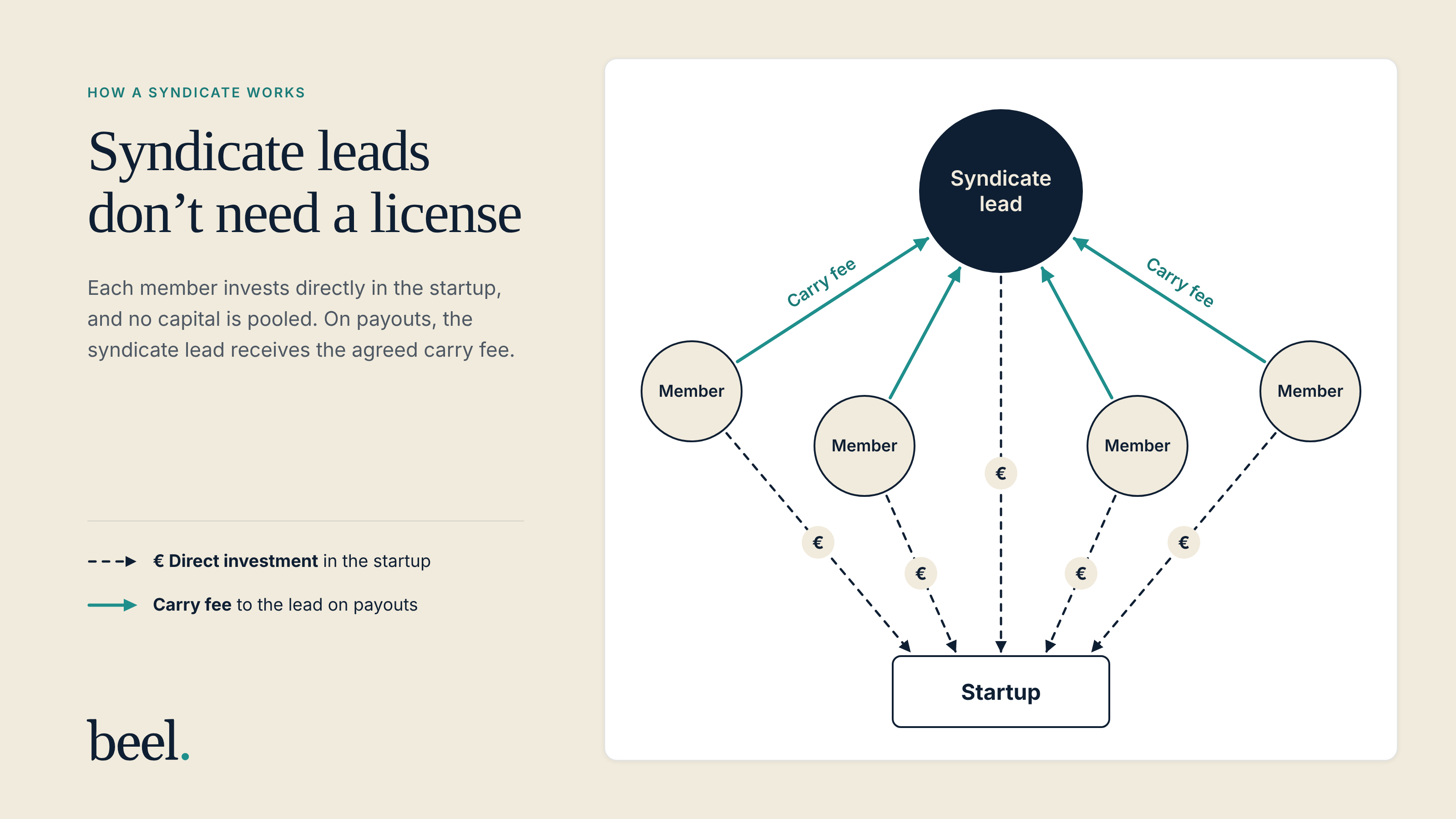
An angel syndicate is a group of private investors who follow an experienced business angel. The angel shares the deals they consider promising. Each member decides on every deal whether to take part, and with how much.
The business angel who runs the syndicate is called the lead. For you as a member, this means:
You see the deals the lead gets from their network.
You decide deal by deal. There is no obligation to invest and no money to pay in upfront.
You choose your ticket size, the amount you invest, for each deal yourself, within the range the lead sets.
You can leave at any time. Investments you have already made stay yours.
Why would a lead share their deals at all? Until now, it was awkward. Passing deals on to friends earns them nothing. Their own fund must be registered with or licensed by the financial regulator and takes a lot of administration.
In a syndicate, the lead instead receives carry. That is a share of the profit the members make on a deal. It only applies once a deal actually ends in a profit, for example when the startup is sold.
For you, this has a simple consequence: how many deals you see depends on how many leads you follow. On beel, the startups are German and Austrian, and members can come from anywhere in the EU.
A syndicate without an SPV: the difference from AngelList
In a beel syndicate, you invest in the startup without a company in between. That is the key difference from the best-known syndicate model from the US.
At AngelList, every syndicate deal gets its own special purpose vehicle, an SPV. Members invest in this vehicle, and only the vehicle holds the stake in the startup. According to AngelList, the investors bear its costs, in proportion to the amount they invest.
At beel, you subscribe, meaning you buy with a binding commitment, to equity profit participation rights (Eigenkapital-Genussrechte) directly with the startup. They give you a share of the startup's profit and sale proceeds, economically like a shareholder. But you have no voting rights, no shareholder status and no entry in the commercial register.
Feature | AngelList syndicate | beel syndicate
|
|---|---|---|
Structure per deal | a separate SPV for every deal | no company in between, equity profit participation rights directly with the startup |
Cost of the structure | usually 8,000 US dollars setup plus 2,000 US dollars regulatory fee, capped at 10 percent of the amount raised | no costs for the members, except the carry fee for the syndicate lead |
Who pays | the investors, pro rata | members pay nothing to beel |
AngelList prices as of October 2026. For international investments, AngelList charges an extra 1,000 US dollars.
This also helps the startup, and in turn you: its shareholder list stays manageable, because syndicate members do not become shareholders. That makes it easier for founders to let a syndicate into the round.
How to recognise a good lead
In a syndicate, choosing the lead is the most important decision you make. These five questions help:
Track record: Has the lead founded companies or invested early, and what became of them?
Own money in the deal: Do they invest themselves, and do they disclose it?
Deal documents: Do they separate facts from their own assessment? Do they name their sources and possible conflicts of interest?
Clear focus: Which sectors and which stage do they invest in, and does that suit you?
Transparent costs: Can you see the carry before you join?
Even a lead with a strong track record can be wrong. These questions help you understand who you are following. They don't take the risk off your hands.
Three leads on beel
Three leads who run a syndicate on beel show what this looks like in practice. The details come from their beel profiles and public sources.
Andy Bruckschlögl is an entrepreneur from Munich. In 2012 he co-founded the software company Ryte, which was acquired by Semrush in 2024, and he co-founded the founders' festival Bits & Pretzels. He invests across sectors in startups at the very earliest funding stages, known as pre-seed and seed. Carry: 15 percent.
Roland Fassauer is a business angel and, by his own account, a co-founder of Intershop and a professor at CODE University in Berlin. According to his beel profile, he has made more than 80 direct investments, including Pliant, Langdock, Superchat and traide. His focus is startups from the CODE University ecosystem, mainly AI and business software. Carry: 20 percent.
Dr Alex von Frankenberg was co-managing director of the High-Tech Gründerfonds, a German early-stage investor, from its founding in 2005 until October 2025. During that time the fund financed more than 780 startups and achieved almost 200 exits (HTGF, as of August 2025). An exit is the sale of a startup or its stock market listing. Among other things, he oversaw EGYM and accompanied the sale of Quentic. Carry: 10 percent.
The companies named show the leads' track record. They are not deals offered through beel. You can find all current syndicates on our syndicates page.
How investing through a beel syndicate works
Investing through a beel syndicate is fully digital and needs no notary appointment. We built the infrastructure so that you can focus on the decision.
Find a syndicate. You can see public syndicates on beel. Private syndicates are reached through an invitation link from the lead.
Apply to join. The lead decides who to admit.
Sign the syndicate agreement. You state roughly what ticket size you have in mind and sign digitally. It is free and does not commit you to any investment.
Review the deal. The lead shares a deal with their assessment. You indicate, without obligation, whether you are in and with how much.
Invest. If the deal is handled through beel, you subscribe to equity profit participation rights digitally, directly with the startup.
Manage your holdings. You see your holdings in your dashboard. Through the beel secondary market, you can offer them to other investors, unless the startup restricts this. Whether a buyer is found is not guaranteed.
On costs: members pay nothing to beel. For the three syndicates featured above, the only cost is the lead's carry, between 10 and 20 percent. You see it before you join.
Conclusion
When people fail to invest in startups, it is often not the money but the access. Rounds are allocated through contacts, and the classic routes, a direct stake or a fund, come with high hurdles. Experienced angels invest across many deals, and for that they rely on their network. A syndicate makes that network, and with it angel investments, available to you: you follow a lead and decide on every deal yourself. So the most important decision is who you follow.
Find your syndicate
On beel, experienced angels run their syndicates, and you decide on every deal whether to join in. Learn more about how to invest in startups with beel, or sign up directly and find your syndicate.
Frequently asked questions
How do I get access to quality deal flow without my own startup network?
Without your own network, an angel syndicate gets you access to deals: you follow an experienced business angel and see the deals they receive through their network. Deal flow means the ongoing stream of such investment opportunities. How many deals you see depends on how many leads you follow.
How can I invest in startups alongside experienced angels?
By joining an experienced business angel's syndicate. The lead shares the deals they consider promising, and you decide on each deal whether to invest and how much. On beel, joining is free and does not commit you to any investment.
What are my options for investing in startups without going into a fund?
You can invest directly as a business angel or join an angel syndicate. The direct route needs your own contacts and, in Germany, a notary appointment for each investment. In a syndicate you decide deal by deal, without being tied to a fund. Your money is still usually locked in until an exit.
How can I invest in startups directly as a private individual?
As a private individual, you invest in startups directly by taking part in a funding round, either through your own contacts or through a syndicate. In a beel syndicate, you subscribe to equity profit participation rights yourself and directly with the startup, with no company in between. A total loss is always possible with startup investments.
Am I invested directly in the company through a syndicate, or only through a vehicle?
That depends on the provider. With some syndicates, AngelList for example, you invest in a special purpose vehicle that in turn holds the stake in the startup. At beel, you subscribe to equity profit participation rights directly with the startup: economically like a stake, but without voting rights, without shareholder status and without an entry in the commercial register.
Can I sell my startup investment before an exit?
Startup investments are usually hard to sell before an exit. beel has a secondary market where you can offer your equity profit participation rights to other investors, unless the startup restricts this. Whether a buyer is found, and at what price, is not guaranteed
)
)
)