
Key takeaways
Profit participation rights (Genussrechte in German) are contracts that let you share in a company's success, for example in its profit, without giving you a voting right.
What such a right gives you is set out in the contract you sign, so these rights can be designed in different ways.
There are two basic types: debt-type rights work much like a loan, equity-type rights work like a stake in the company.
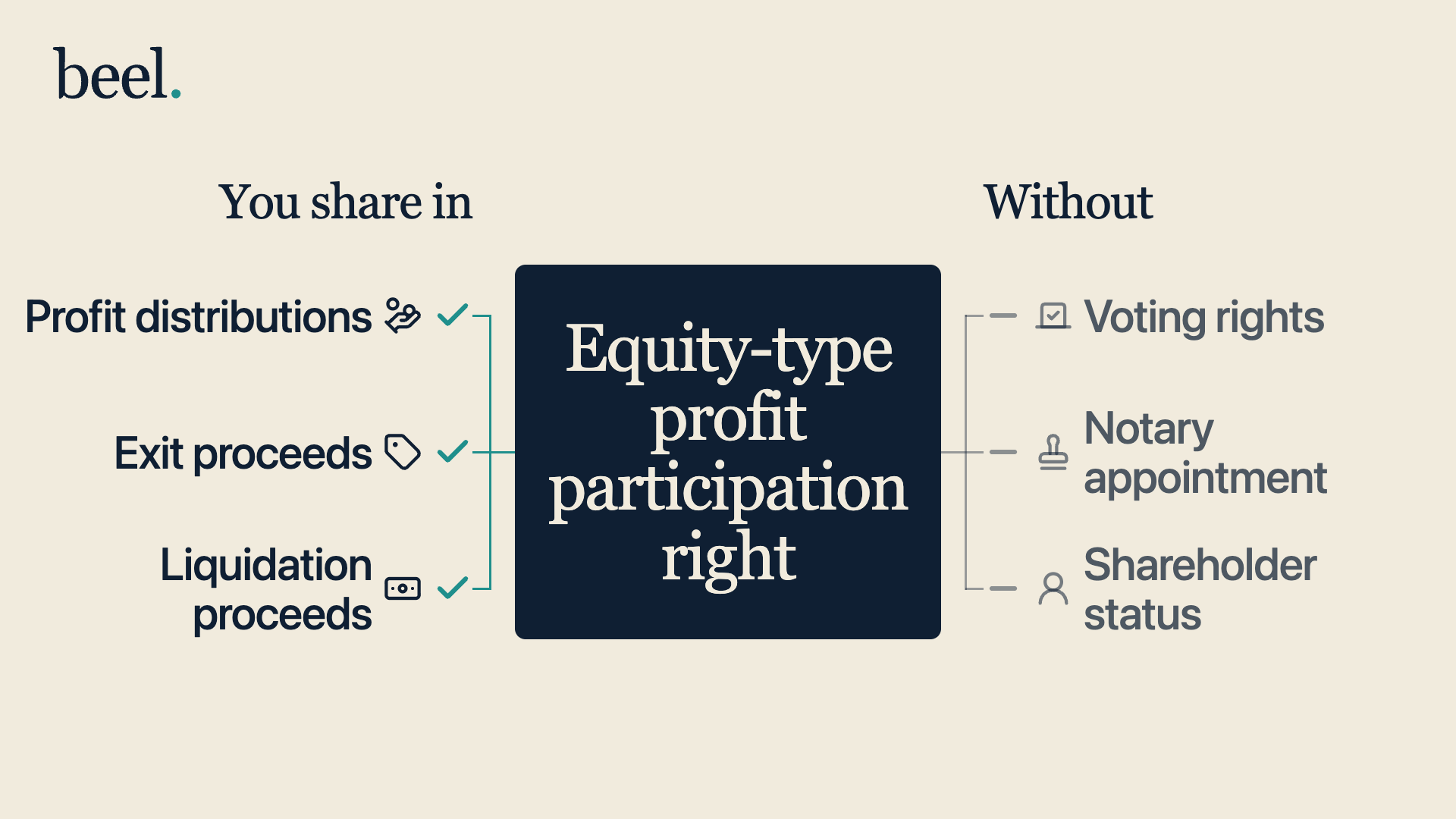
For startup investments, the equity type is the one that matters: you share in the profit, in the sale proceeds at an exit and in the liquidation proceeds. You do not become a shareholder.
At beel, equity-type rights put you in the economic position of a shareholder, without a voting right and without a notary appointment. They are transferable, but a sale before an exit is not guaranteed.
Investing in startups this way is risky, and a total loss is possible.
Profit participation rights are a way to invest in a startup without becoming a shareholder. This article explains what they are, the two types that exist and how they let you share in a startup's success. At the end, you will see how they compare with the other ways to invest in a startup in Germany.
What are profit participation rights? A simple explanation
Profit participation rights are contractual rights that let you share in a company's economic success, for example in its profit or in the proceeds when the company is sold. A voting right is not part of them. Holders are therefore not shareholders but contractual partners of the company.
What one of these rights gives you is set out in the contract you sign, so they can be designed in different ways. Startups that raise capital through beel use a standard template that puts investors in the economic position of shareholders.
For startups, equity-type Genussrechte are attractive: they can raise capital without taking on new shareholders and changing the shareholder list at the commercial register.
Genussrecht or Genussschein: what is the difference?
A Genussschein is a Genussrecht issued as a security. Genussscheine can be traded on the stock exchange and are mainly issued by larger companies.
Startups usually issue Genussrechte without a security. They are agreed by contract directly between you and the company.
The two basic types: debt-type and equity-type
Genussrechte fall into two basic types: they resemble either a loan or a stake in the company.
Debt-type right. You receive fixed or profit-linked interest and get the amount you paid in back at the end of the term, unless the contract provides for a share in losses. A subordination clause is often agreed, and then the right resembles a subordinated loan, meaning a loan that is repaid only after the other creditors if things go wrong. You find this type, for example, in projects with predictable income, such as renewable energy.
Equity-type right (Eigenkapital-Genussrecht). You share in the profit and in the liquidation proceeds. For startups, the contract usually also covers a share of the sale proceeds at an exit, meaning when the startup is sold. There is no fixed interest and no fixed repayment amount. Economically, this resembles a share in a GmbH without a voting right.
Feature | Debt-type right | Equity-type right
|
|---|---|---|
Return | fixed or profit-linked interest | share of profit, sale proceeds and liquidation proceeds |
Repayment | amount paid in, at the end of the term | no fixed amount, proceeds at exit or wind-up |
Economically similar to | a loan, often subordinated | a share in the company without a voting right |
Upside | limited to the interest | grows with the company's value |
For startup investments, the equity type fits: a young company does not create value through ongoing interest, but at the exit.
How you share in the success: exit, profit, insolvency
With an equity-type right, your result depends on what becomes of the startup. Three outcomes are possible.
The startup is sold. An example: you invest 25,000 euros in a startup valued at 5 million euros after the funding round. Your right is then economically equivalent to a stake of 0.5 percent. Seven years later, the startup is sold for 20 million euros. With no further funding rounds, you are entitled to 0.5 percent of the sale proceeds, or 100,000 euros.
In practice, further rounds usually follow before an exit. Every new investor reduces your stake, which is called dilution. If two later rounds each issue 20 percent in new stakes, your stake falls to 0.32 percent. At the same sale price, you then receive 64,000 euros. Later investors can also secure the right to get their money back first in a sale, known as a liquidation preference. That can reduce your amount as well.
You can negotiate additional rights with the startup to counter both effects. A pro rata right, for example, lets you invest again in later rounds and so keep your stake. At beel, this can be recorded in an addendum to the standard contract, known as a side letter.
The startup makes a profit. Then you share in distributions. In the build-up phase, startups usually distribute nothing and put every euro into growth. It gets interesting when the company keeps growing and makes a profit: if that profit is distributed, you receive your share, even without an exit.
The startup fails. Many contracts include a subordination clause: in insolvency proceedings, you are paid only after the other creditors (Section 39 (2) InsO). When a startup fails, there is usually nothing left for that. This is the biggest risk of this kind of startup investment: a total loss is possible.
Pros and cons for you as an investor
The biggest advantage of an equity-type right is a financial stake without a notary and without shareholder status; the biggest disadvantage is the lack of a voting right.
Pros:
You share in the startup's success, including at the exit.
You do not need a notary appointment, and the deal can be closed digitally.
You can transfer the right by contract, if the contract allows it. Transferring a share in a German GmbH requires a notary (Section 15 (3) GmbHG).
You have no obligations as a shareholder.
Cons:
You have no voting right.
If subordination is agreed, you come last in insolvency. A total loss is possible.
Finding a buyer before an exit is not guaranteed for startup investments.
How much the missing voting right matters depends on your stake. In a German GmbH, shareholders decide by simple majority, and changes to the articles of association need three quarters of the votes (Section 53 (2) GmbHG). Anyone holding less than 25 percent therefore cannot block a decision even as a shareholder, unless the articles provide otherwise, but is involved in every resolution. That means effort for you and less flexibility for the startup.
Profit participation rights compared: GmbH share, convertible loan, SPV
Among the ways that give you the economic position of a shareholder, an equity-type right involves the least effort: no notary and no company in between.
Route | Notary needed | Voting right | Shares in the exit
|
|---|---|---|---|
GmbH share via a capital increase | yes | yes | yes |
Convertible loan | at conversion | only after conversion | usually only after conversion |
Investment through an SPV | yes, to set up the SPV and for its investment | only through the SPV | yes, through the SPV |
Equity-type right | no | no | yes |
GmbH share. As a shareholder, you have the strongest position, including a voting right. In return, every investment requires a capital increase (Kapitalerhöhung), in which the startup issues new shares in front of a notary, and an updated shareholder list at the commercial register. Many startups are therefore reluctant to take on many small investors. Sought-after startups that plan to bring in VCs later keep their shareholder list short, and there is often no room for individual business angels.
Convertible loan. You first provide a loan that is later converted into a stake. The contract needs no notary, but the conversion is followed by a capital increase after all. Our article on the convertible loan shows what that costs.
SPV. An SPV (special purpose vehicle) is a separate company that pools the money of many investors and invests in the startup. You are only involved indirectly, and the investors bear the costs of setting it up and running it. These costs are easy to underestimate: as a rule, every investment needs its own SPV, with its own bookkeeping, annual accounts and tax return. Effort and costs grow with every deal.
Equity-type right. You invest directly in the startup, with no notary and no company in between. The "price" is the lack of a voting right. With a small stake, however, you would have little say as a shareholder either.
For a more detailed comparison, see our knowledge base article How do profit participation rights compare to convertible loans, capital increases and SPVs?
How they are taxed
From an investor's point of view, equity-type rights at beel are taxed similarly to a share in a GmbH. No VAT is charged. How your income is taxed in your case depends on your personal situation and your country of residence. Clarify this with your tax adviser before you invest.
What to look for in the contract
It pays to read the contract carefully before you sign. These six questions help you:
Participation: Do you share only in the profit, or also in the sale and liquidation proceeds?
Stake: What percentage of the company is your right equivalent to? That determines how much of the sale proceeds reaches you.
Order of payment: Who gets money first at an exit, meaning are there liquidation preferences? And do you rank behind the other creditors in insolvency?
Term and termination: Can the company terminate, and at what amount?
Transfer: Are you allowed to sell your right, and does it need consent?
New rounds: What happens to your stake when new investors come in, and do you have a pro rata right?
At beel, a standard template governs these points in the same way for every startup. Additional rights such as a pro rata right or a separate liquidation preference can be agreed in a side letter. Our knowledge base article What is in the beel standard contracts? explains what the standard contracts contain.
Equity profit participation rights at beel
At beel, you invest through equity-type rights (Eigenkapital-Genussrechte) that put you in the economic position of a shareholder. Whenever money flows to the shareholders, you receive your share: when profits are distributed, at an exit and if the company is wound up. Our knowledge base article How do I receive dividends, exit and liquidation proceeds? explains how the payout works.
You have no voting right, no shareholder status and no entry in the commercial register. You do not need a notary appointment, and you subscribe digitally, directly with the startup.
Your rights are transferable. Through the beel secondary market, you can offer them to other investors, even before an exit, if the startup allows trading. If a startup develops well, this can be a way to get money back earlier. Whether a buyer is found, and at what price, is not guaranteed. More on this: Can I sell my profit participation rights?
You get access to deals through angel syndicates. Business angels with a track record share individual investment opportunities that you would hardly reach on your own, and you decide on every deal yourself. See What is an angel syndicate?
Conclusion
Genussrechte let you share in a company's success, but without a voting right. What they give you is set out in the contract. For startup investments, the equity type is the one that matters, because it lets you share in the exit economically like a shareholder. In the example, you were entitled to 100,000 or 64,000 euros before tax, and a total loss is just as possible. Compared with a GmbH share, a convertible loan or an SPV, the advantage is less effort for the same economic stake. You give up the voting right, but with a small stake you would have little say as a shareholder either.
Invest in startups with beel
At beel, you invest directly in startups from Germany and Austria through Eigenkapital-Genussrechte, digitally and without a notary. Investors can join from anywhere in the EU, and you get access to deals through the syndicates of business angels. Find out more about how our equity profit participation rights work, or see directly how to invest with beel.
Frequently asked questions
Are profit participation rights equity or debt?
That depends on the contract. Rights that share in success and losses like equity, run long-term and rank behind creditors if things go wrong count as equity in the company's balance sheet. Rights with fixed interest and repayment of the amount paid in are closer to a loan.
Do I get a voting right?
No, these rights do not give you a voting right. You are a contractual partner of the company, not a shareholder. You therefore do not vote at the shareholders' meeting.
Am I invested directly in the startup, or only through a vehicle?
With these rights, you invest directly in the startup, because the contract is between you and the company. With an SPV, by contrast, you invest in a separate company that in turn invests in the startup.
Can I sell profit participation rights before an exit?
Yes, if the contract allows the transfer. You do not need a notary for it. Finding a buyer for a startup investment is difficult, though. At beel, you can offer your rights on the secondary market if the startup allows it. Whether a buyer is found is not guaranteed.
What happens to my investment in insolvency?
If subordination is agreed, you are paid only after the other creditors. This also applies to the equity-type rights at beel. When a startup fails, there is usually nothing left for that, so a total loss is possible.
What is the difference between a profit participation right and a share of stock?
A share of stock makes you a shareholder in a stock corporation, usually with a voting right at the general meeting. A Genussrecht is a contract that lets you share in the economic success, without a voting right. Companies of any legal form can issue Genussrechte, including a German GmbH.