)
Key takeaways
A convertible loan is a loan that is repaid in company shares at a later conversion instead of in cash.
Discount and cap are the two levers that decide at what valuation the loan converts and how many shares the investor gets.
The contract is signed quickly. The work comes later and falls into three blocks: the capital increase, the pooling vehicle many founders end up building, and the rights and duties every new shareholder brings with them.
How much time a convertible loan costs founders is badly underestimated. Capital increase, coordination with lawyers, scheduling and shareholder resolutions eat time the startup needs elsewhere.
For three convertible loans of 100,000 euros each, the pure cash burden comes to roughly 6,500 to 10,300 euros, one off.
The convertible loan (Wandeldarlehen) is a popular way for German startup founders to raise money. It promises a simple, low-cost process, because the valuation question and the investor's actual stake are pushed into the future. What most founders do not see is the follow-up work it creates, especially when they go through the process for the first time. The real work does not start with the contract templates. It starts on the day the loan converts into company shares. This article walks through those steps and the costs that nobody budgets for.
What is a convertible loan?
A convertible loan is a loan under which the investor has the right to convert their repayment claim into company shares on defined terms. In Germany it is called a Wandeldarlehen; in English you will also see convertible note.
It is used mainly in the pre-seed and seed phase for business angel financing, and as a bridge between two rounds.
The appeal: no valuation has to be agreed when the contract is signed. Instead of negotiating a number, both sides agree on a formula that governs the conversion later on. The convertible loan converts at the valuation of the next financing round minus a discount, or at a maximum valuation agreed up front (the "cap").
Discount and cap: the two levers
Discount and cap are the two terms in a convertible loan that decide at what valuation it converts and how many shares the investor gets for it.
The discount is a percentage reduction on the valuation of the next round and rewards the early risk. It usually sits between 15 and 30 percent.
The cap puts a ceiling on the valuation. It protects the investor: if the valuation jumps in the next round, they still convert at the valuation the cap sets.
What matters is how cap and discount interact. Only one of the two applies, never both together: the convertible loan converts at whichever value is better for the investor.
Better for the investor means the lower valuation. The lower the conversion valuation, the more shares they get for their money. Here is what that looks like in practice.
The agreement: a 100,000 euro convertible loan, 20 percent discount, cap at 4 million euros. We leave interest out to keep it simple.
Case 1, the round goes well. The new investor values the company at 8 million euros pre-money. The discount would give a valuation of 6.4 million euros. The cap puts the ceiling at 4 million, which is the lower value, so conversion happens at 4 million. The investor receives 2.5 percent of the company, worth 200,000 euros at the price of the new round: the 100,000 euro convertible loan has doubled on paper.
Case 2, the round turns out weaker. The pre-money valuation is 2.5 million euros. The discount gives a valuation of 2 million euros. The cap of 4 million sits above that and therefore does not apply. Conversion happens at 2 million, and the investor receives 5 percent of the company, twice as much as in the first case.
What belongs in a convertible loan contract
A contract for a convertible loan governs four things that regularly cause friction at conversion:
the conversion triggers,
the conversion formula,
the subordination (Rangrücktritt) and
the form requirement.
Conversion triggers: usually the next qualified financing round above a defined minimum volume, an exit, and a long-stop date by which the loan must convert or be repaid. The long-stop date gets the least attention, yet it is the case that applies when nothing happens: if the next round does not materialise, the convertible loan falls due.
Conversion formula: the rules on discount, cap and interest.
Subordination (Rangrücktritt): with a subordination the investor voluntarily moves to the back of the queue. In an insolvency their claim is only served once every other creditor has been paid, which in practice means they see nothing. In return, the convertible loan does not count as a liability in the over-indebtedness test (Überschuldungsstatus). Without the subordination it sits on the balance sheet like any other loan, and in a startup with little equity that alone can trigger technical over-indebtedness. Management then has six weeks to file for insolvency. That is why subordination is standard.
The form requirement is the unpleasant part. In 2022 the Higher Regional Court of Zweibrücken ruled that the signature of the subscriber must be notarially certified if they are not yet a shareholder. The court also saw a notarisation requirement for the resolution preparing the conversion.
A formal defect hits both sides: the contract can be void, the repayment claim immediately due, and the conversion right unenforceable. How you handle this depends on the specific drafting and should be checked by a lawyer before signing.
A ready-made standard contract package for convertible loans usually costs under 1,000 euros net. As soon as you deviate from the standard, you move to hourly rates that quickly exceed that. A common mistake is to count only this cost against the convertible loan. The next section shows what actually comes on top.
Three cost blocks come after signing
Up to this point a convertible loan is a fairly manageable instrument. The real effort starts on the day it converts, and it falls into three blocks that work differently.
The capital increase is a one-off but expensive act. The pooling vehicle many founders build to keep the cap table clean is a permanent burden. So are the shareholder rights and duties that every new name in the commercial register brings with it.
All three generate legal fees. In German corporate law, hourly rates average around 255 euros net for associates and 328 euros for partners; large firms with a dedicated corporate team charge 400 to 600 euros.
The rough sequence is shown in the illustration below.
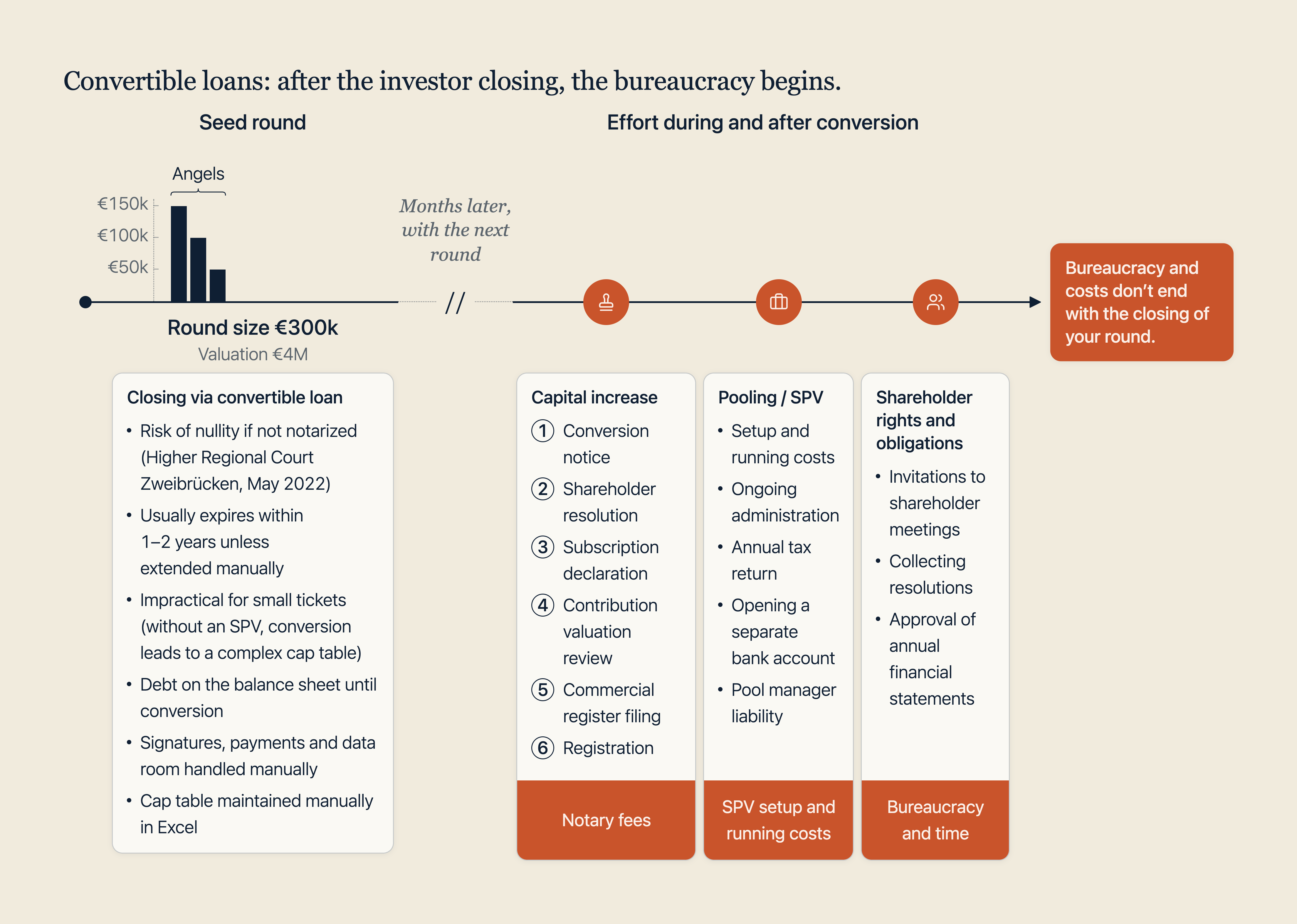
Block 1: The capital increase
A convertible loan is almost always converted through a capital increase in which the convertible loan claim is contributed as a contribution in kind (Sacheinlage). The sequence:
Conversion notice. The investor declares the conversion, or the contractual trigger occurs.
Shareholder resolution on the capital increase. It needs at least three quarters of the shareholder votes and must be notarised (section 53 (2) GmbHG).
Subscription declaration. The new shareholder subscribes the share, usually at a nominal value of one euro. The declaration must be recorded or certified by a notary.
Valuation check. The registry court checks whether the contributed claim is still worth its nominal amount. If it is not, for example because the company can no longer service the convertible loan, the investor is liable for the difference (Differenzhaftung) and has to pay it in cash. This is a frequent source of conflict.
Filing with the commercial register. Management files the capital increase and submits the new shareholder list.
Registration. Only on registration does the capital increase take effect.
Now to the costs. The notary does not charge on the nominal value of the new shares but on the transaction value (Geschäftswert), meaning what the shares are actually worth. This is where most founders misjudge the bill. If three angels convert 100,000 euros each and receive shares with a combined nominal value of 3,000 euros, the notary does not calculate on 3,000 euros but on 300,000 euros.
Here is what a conversion at a transaction value of 300,000 euros roughly costs.
Item | Calculation | Amount at a 300,000 euro transaction value
|
|---|---|---|
Statutory fee unit at a 300,000 euro transaction value | basis for the calculation, not a separate item | 635.00 euros |
Notary: notarisation of the shareholder resolution | 2 × fee unit | 1,270.00 euros |
Notary: filing with the commercial register | 0.5 × fee unit | 317.50 euros |
VAT on the notary fees | 19 percent on 1,587.50 euros | 301.63 euros |
Commercial register court fee | fixed amount, no VAT | 315.00 euros |
Total of the mandatory items | 2,204.13 euros |
The 2,204.13 euros are the minimum you have to budget for. Without them the conversion does not happen. On top of that come, depending on the setup, certification of each subscription declaration at up to 70 euros per signature, an execution fee for the new shareholder list of up to 250 euros, and expenses for postage and documents. With three investors you realistically land between 2,500 and 3,300 euros, roughly one percent of the converted amount.
The bigger item is still to come: legal fees. Resolution, subscription declarations, shareholder list and filing all have to line up, and with several investors the coordination multiplies. For a convertible loan conversion with three investors you should budget 10 to 20 hours, which at the hourly rates above means 3,000 to 6,000 euros. There is no ceiling: the more bespoke the contracts and the more advisers on the investor side, the longer the coordination takes.
With one investor this stays manageable. With three it becomes a project: three certified subscription declarations, one joint notary appointment for the resolution, and three more names on the shareholder list.
Block 2: The pooling vehicle or SPV
To avoid every angel appearing individually in the commercial register after the convertible loans convert, many startups bundle investors into a pooling vehicle, a separate company that acts as a single shareholder. That solves the register problem and creates a new one: a second company you have to run, keep books for and file taxes for.
Setting it up costs around 934 euros for a GmbH with bespoke articles, of which 709 euros go to the notary and 225 euros to the commercial register. A model protocol is cheaper, but the standard articles rarely fit an investment structure. On top of that comes the share capital of 25,000 euros, at least half of which must be paid in before registration. That is not a fee, but money tied up in the vehicle.
On an ongoing basis you face what every corporation faces, even if the vehicle only holds shares. The figures below are mid-range fees under the German tax advisers' fee schedule (StBVV) and move with the asset value and the number of documents:
Annual accounts with notes plus corporate and trade tax returns: around 1,374 euros net
Ongoing bookkeeping: around 605 euros net at 40 documents a year
Publication in the company register: around 20 euros a year
Transparency register: 19.80 euros a year
Business account, chamber of commerce contribution, and the management time nobody invoices
Together you land at roughly 2,000 euros net a year, permanently, per vehicle. For a 300,000 euro round that is about 0.7 percent of the capital raised, every year. With small tickets this effort quickly becomes disproportionate to the amount invested, and at exit the winding-up of the vehicle comes on top.
Block 3: Shareholder rights and duties
The third block appears on no invoice and costs anyway. Anyone registered as a shareholder brings rights that the law gives them.
Adopting the annual accounts. Adopting the annual accounts and deciding on the use of the result is a matter for the shareholders. Every year, with all of them, unless the articles provide otherwise.
Convening meetings. Section 51 GmbHG requires invitations by registered letter with at least one week's notice. The articles can provide for a simpler form, for example email. If they say nothing, registered letters apply, and with twelve shareholders that means twelve registered letters and finding a date across twelve calendars.
Passing resolutions. Every amendment to the articles needs three quarters of the votes and the notary again (section 53 (2) GmbHG). That means every new financing round, every change to the participation programme and every adjustment of the corporate purpose triggers notary fees based on the transaction value.
Providing information. Under section 51a GmbHG, management must without delay give every shareholder information about the affairs of the company on request and allow inspection of books and records. The articles cannot deviate from this provision. So a small investor holding 0.5 percent can ask to see the books, and management has to deliver.
Transferring shares. If one of the angels wants to sell later, the assignment of the share must be notarised. A new shareholder list then goes to the commercial register.
For the next VC round this is exactly where it gets uncomfortable. An investor will check in due diligence who has a say, who holds veto rights and how laborious future resolutions will be. Twelve micro-shareholders with voting rights turn every amendment to the articles into a scheduling exercise and every consent into a separate negotiation. Our guide explains how such a review works: what a due diligence involves.
The alternative: participation without shareholder status through equity profit participation rights
All three cost blocks a convertible loan brings with it hang on the same decision: whether the investor ends up in the commercial register as a shareholder. If they do not, the capital increase falls away, the pooling vehicle becomes unnecessary, and the shareholder rights never arise in the first place.
That is what equity profit participation rights (Eigenkapital-Genussrechte) are for. Holders are placed economically like shareholders, sharing in profits as well as in exit and liquidation proceeds. But they receive no voting rights, no shareholder status and no entry in the commercial register. The individual subscription needs no notary appointment. What is needed once is a shareholder resolution covering the issue of the profit participation rights, and that resolution does not have to be notarially certified.
We at beel built our infrastructure for exactly this case: closing angel rounds digitally, without booking a notary appointment for every investor. You get legally reviewed standard templates and bring investors on board while you fundraise. Investors subscribe digitally, in minutes. After that no further work is required; you only pay our fees.
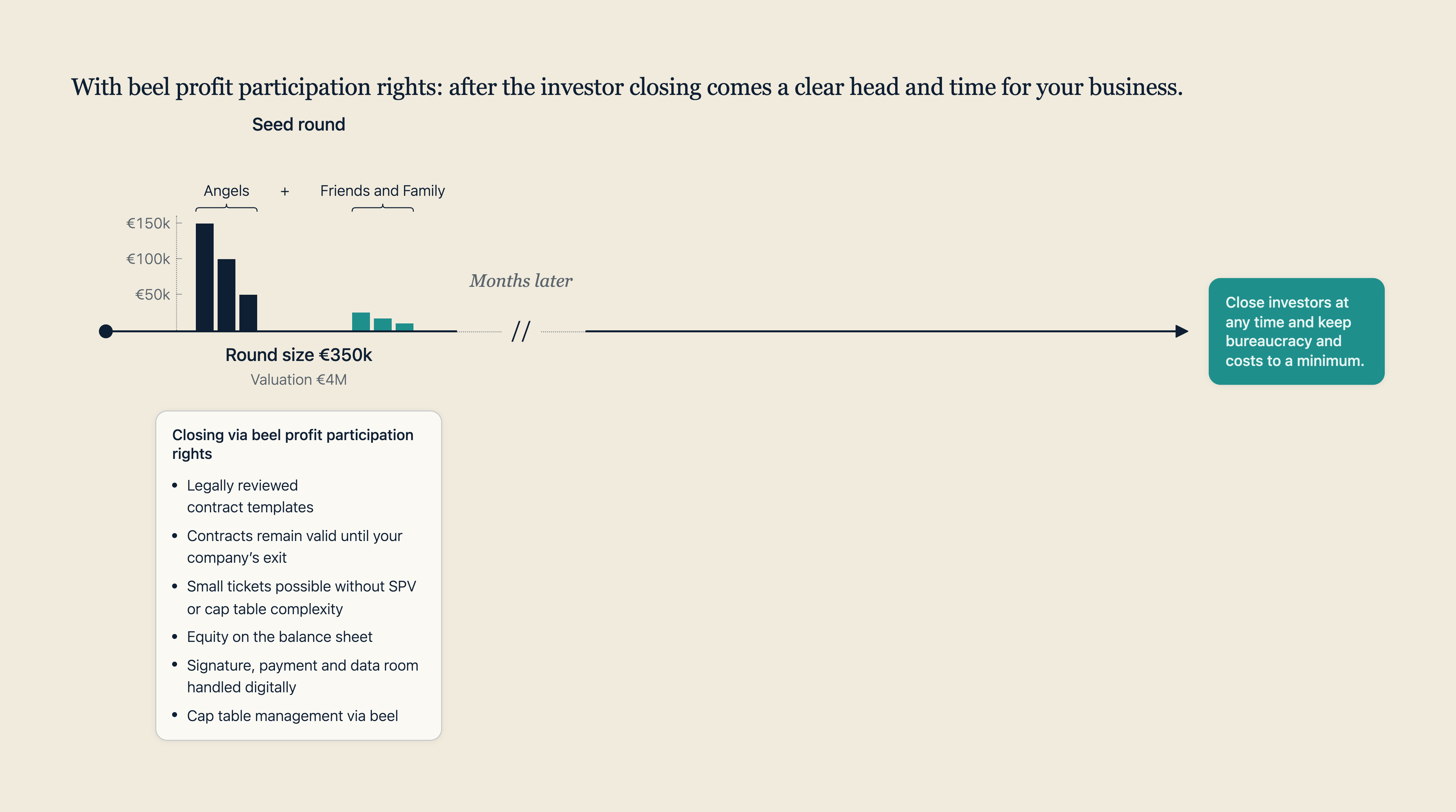
The four routes compared
Convertible loan, capital increase, pooling vehicle and equity profit participation right differ less in how they are closed than in what work and cost they leave behind.
Feature | Convertible loan | Capital increase | Pooling / SPV | Equity profit participation right
|
|---|---|---|---|---|
Notary required? | no, but disputed | yes | yes | no |
One-off costs | contract drafting, flat (approx. 1,000 euros net) or hourly | rises with the investment value, approx. 2,204 euros at 300,000 euros | around 934 euros to set up, plus 25,000 euros share capital tied up | |
Ongoing costs | none until conversion | none | around 2,000 euros net a year | none once the fundraise is closed |
Entry in the commercial register | yes, on conversion | yes | yes | no |
Voting and information rights | yes, after conversion | yes | indirect | no |
Conclusion
From a founder's point of view, a convertible loan promises an uncomplicated way to take in capital. It defers the valuation question and brings money into the company without anyone having to fix a number today.
What many founders underestimate are the costs and, above all, the work that follows at conversion. Lawyers, notaries, shareholders and pooling vehicles cost time and money that founders do not have.
Adding up the figures from this article for three business angels investing 100,000 euros each gives this picture:
Contract package for the convertible loans: around 1,000 euros
Notary and register court at conversion: 2,500 to 3,300 euros
Legal support for the conversion: 3,000 to 6,000 euros
That is roughly 6,500 to 10,300 euros, one off. Add a pooling vehicle and you pay around 934 euros to set it up plus about 2,000 euros net every year for as long as the vehicle exists.
What cannot be priced is the stress, the time and the coordination effort sitting on the founders. beel offers an alternative: your infrastructure for closing investments digitally and keeping the follow-up work to a minimum.
Close an angel round without a notary appointment
If you want to close an angel round without booking a notary appointment for everyone involved, we cover the whole sequence in one standardised process: resolution, subscription, identity verification and the ongoing administration of the profit participation rights, all in one place. See how a round works at beel.
Frequently asked questions
How do I clean up several convertible loans without an expensive capital increase?
Avoiding the capital increase entirely only works if the loans are not converted into real company shares. In practice that means investors move into an instrument that works economically like a stake but does without shareholder status, such as an equity profit participation right. This requires the existing contracts to allow such a replacement, and should be checked beforehand.
What does converting a convertible loan cost?
Notary fees for a convertible loan are based on the transaction value, which is measured by what the new shares are worth, not by their nominal amount. At a transaction value of 300,000 euros, notarisation, filing and the register fee come to around 2,204 euros. Legal support, at hourly rates from about 255 euros net, usually costs more than the notary.
How do convertible loans, capital increases and pooling structures differ in an angel round?
The convertible loan closes fastest but pushes the work into the future. The capital increase settles everything immediately, at the price of notary appointments and a longer shareholder list. Pooling structures keep the commercial register tidy but create set-up costs and around 2,000 euros net of administration a year.
How do I keep my cap table clean when 10 or more angels invest?
What matters is whether each investor becomes a shareholder in their own right. If the stakes stay off the shareholder list, through a pooling vehicle or through equity profit participation rights, the cap table stays as tidy as before, whatever the number of investors.
What are the alternatives to an SPV if I want to bundle many small investors?
The workable alternatives in Germany are participation instruments that need no separate company, above all equity profit participation rights. They bundle the economic stake contractually, without a vehicle having to be founded, accounted for and administered every year.
What do we need as a founding team to close an angel round cleanly without a lawyer and a notary?
It does not work entirely without legal review, but the review happens once instead of per investor. You need a reviewed standard contract package, a one-off shareholder resolution, a data room for the documents and a process for subscription and identity verification. After that you can take on further investors without a notary appointment or a fresh contract negotiation for each one.
)
)
)