
Key takeaways
In a German GmbH, anyone holding more than 25 percent of the votes has a blocking minority. It lets them block every resolution that needs three quarters of the votes cast.
They can block amendments to the articles of association, capital increases, the dissolution of the company and mergers. Decisions on managing directors, the annual accounts and instructions to management are made by simple majority.
An angel round through a capital increase shifts the votes: if a GmbH with two founders at 50 percent each issues new shares worth 15 percent to angels, each founder then holds 42.5 percent.
Below 50 percent, a founder who is also managing director is usually subject to social security contributions. That changes only if the articles of association give them a comprehensive blocking minority.
With equity profit participation rights, investors share in the economics but have no votes. The voting structure of the GmbH stays the same.
Anyone planning a first funding round thinks about valuation and amount, less about votes. Yet every capital increase decides who can shape the company later: the GmbH issues new shares, and the investors become shareholders with voting rights. If one investor holds more than 25 percent, or several vote together, they can block key decisions. And even the first round can change the founders' status in German social security.
What is a blocking minority in a GmbH?
A blocking minority (Sperrminorität) is held by anyone in a GmbH with more than 25 percent of the votes, because that is enough to stop resolutions that need a three-quarters majority. German law requires this majority above all for amending the articles of association (Section 53 (2) GmbHG). The articles of association (Gesellschaftsvertrag or Satzung) are the GmbH's constitution: they set out its name, purpose, share capital and the rights of its shareholders. The share capital (Stammkapital) is the amount fixed in the articles that the shareholders pay in. It grows with every capital increase.
Votes follow capital: every euro of a share in the GmbH (Geschäftsanteil) carries one vote. Someone holding exactly 25 percent cannot stop a resolution passed with exactly 75 percent. Only 25 percent plus one vote is enough. That is why negotiations talk about 25.1 percent.
One caveat: only votes actually cast are counted. A shareholder who neither attends the shareholders' meeting (Gesellschafterversammlung, where all shareholders pass resolutions) nor sends a proxy blocks nothing.
What a blocking minority can and cannot prevent
The 25 percent threshold applies to fundamental decisions, not to day-to-day business. Unless the articles of association say otherwise:
Resolution | Majority required by law | Can more than 25 % block it? |
|---|---|---|
Amending the articles, e.g. name or business purpose | three quarters | yes |
Capital increase, i.e. issuing new shares | three quarters | yes |
Dissolving the GmbH | three quarters | yes |
Merging with another company | three quarters | yes |
Appointing or dismissing managing directors | simple majority | no |
Approving the annual accounts, using profits | simple majority | no |
Instructions to management | simple majority | no |
The capital increase is on the list because it amends the articles: the share capital is written into them, and it grows. So anyone with more than a quarter of the votes can hold up future funding rounds that issue new shares. One exception is authorised capital (genehmigtes Kapital): the articles can authorise management to increase the share capital for up to five years without a new resolution. That authorisation itself, however, needs three quarters of the votes.
The articles of association can set stricter majorities, but never less than three quarters for amendments to the articles. If they require 90 percent for certain resolutions, for example, just over 10 percent is enough to block them. What your GmbH's articles say therefore matters more than the statutory rule.
Statutory, extended and comprehensive blocking minority
How far a minority shareholder's power to block reaches depends on where it comes from. A minority shareholder is anyone with less than half of the votes. There are three forms:
Statutory blocking minority: more than 25 percent of the votes. It only applies to resolutions that need three quarters.
Extended blocking minority: the articles of association require higher majorities for further resolutions or give a shareholder a veto, for example over selling key patents.
Comprehensive blocking minority: a shareholder can stop every resolution of the shareholders' meeting, including instructions to management. This only works through a clause in the articles of association, such as a unanimity requirement. Germany's Federal Social Court also calls it a genuine or qualified blocking minority.
To block fundamental decisions, the statutory form is enough. For social security, only the comprehensive form counts, as explained below.
Why investors negotiate for 25.1 percent
Whoever can block a capital increase has a say in every further round. That is why some investors negotiate specifically for a stake just above 25 percent. It is not mistrust but protection: without the investor's consent, the founders can neither bring in new investors on different terms nor change the business purpose.
Individual business angels, private individuals who invest their own money in startups, usually stay below the threshold with their ticket, the amount a single investor puts in. Several angels together, however, can exceed 25 percent if they vote together.
Venture capital funds (VCs), professional investors managing third-party money, do not rely on the 25 percent threshold alone. They also secure their say through consent rights in the investment agreement, the contract between founders, investors and the GmbH covering the round. It lists decisions that cannot be taken without their approval.
How an angel round shifts the votes: a worked example
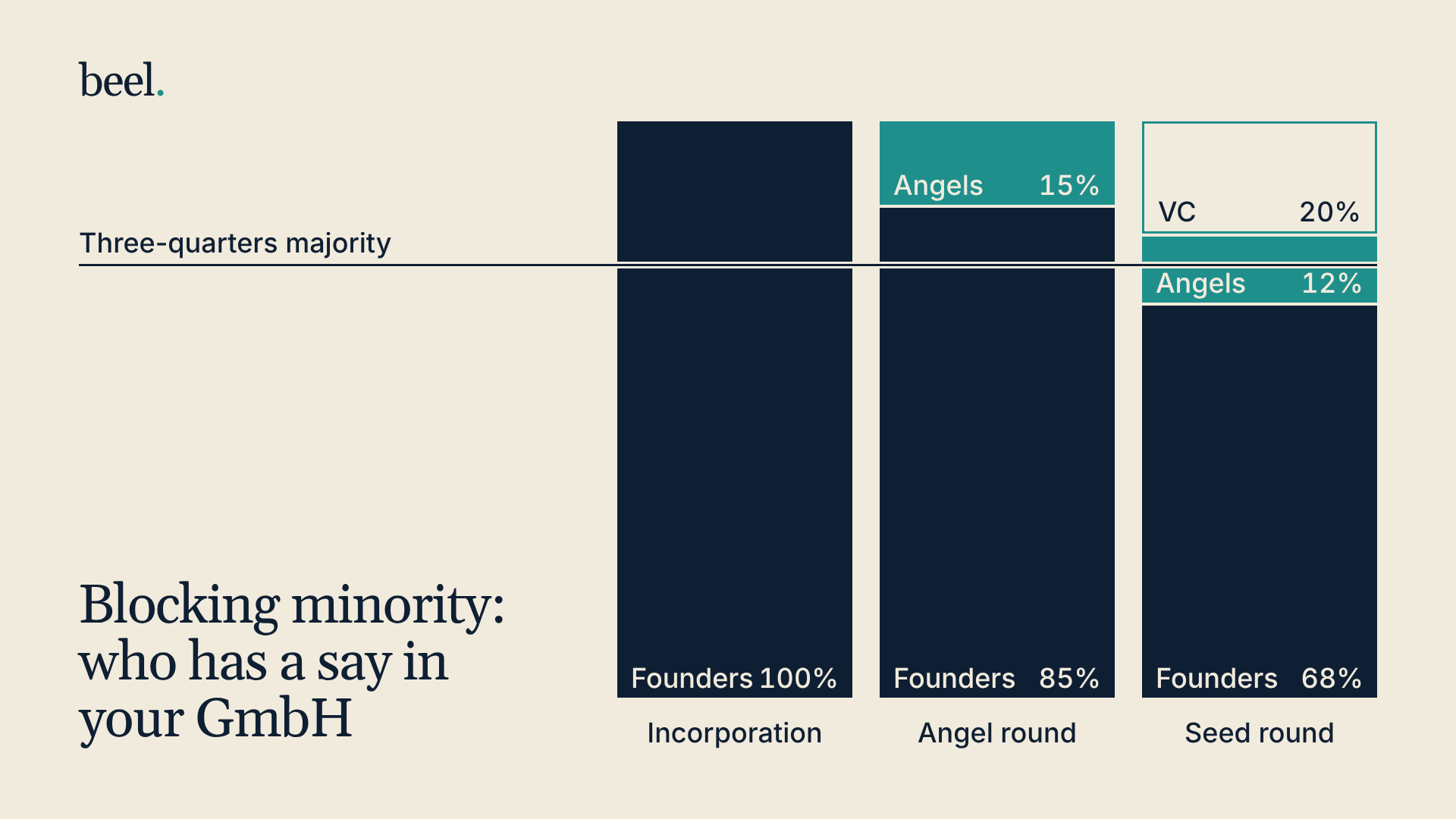 An angel round, the first funding from several business angels, shifts the votes immediately and permanently when it runs through a capital increase. An example with two founders, both rounds through new shares:
Point in time | Founders A and B (each) | Angels (combined) | VC |
|---|---|---|---|
Incorporation | 50 % | 0 % | 0 % |
After the angel round (15 %) | 42.5 % | 15 % | 0 % |
After the seed round (20 %) | 34 % | 12 % | 20 % |
The seed round is the first larger funding round, usually led by a VC. Three thresholds are crossed along the way:
After the angel round, each founder is below 50 percent. Under company law this changes little, as together they still hold 85 percent. For social security, however, it can already make the difference.
After the seed round, the founders hold 68 percent together. That is less than three quarters. For every further capital increase and every amendment to the articles, they now need votes from investors.
Angels and VC together reach 32 percent. If they vote together, they can block amendments to the articles. Conversely, each founder can now do so alone with 34 percent.
Then there is the follow-up effort. Every amendment to the articles needs a resolution of the shareholders' meeting, notarised by a German notary. All shareholders must be invited to that meeting. With eight angels, that means ten shareholders instead of two, for every round and every amendment. What a capital increase costs at the notary is broken down in our article on the convertible loan.
Blocking minority and social security: what founder-managing directors should know
A founder who is also managing director only counts as self-employed if they hold at least half of the votes or the articles of association give them a comprehensive blocking minority. That is the position of Germany's Federal Social Court. Without either, they count as an employee of their own GmbH and are subject to social security contributions. Agreements outside the articles, such as a contract between the founders to vote together, do not change this.
In the worked example, both founders drop from 50 to 42.5 percent with the angel round. If the articles do not give them such a veto over all resolutions, contributions become due from the moment the capital increase is entered in the commercial register (Handelsregister). In 2026, pension and unemployment insurance alone cost 21.2 percent of salary, calculated on salaries up to 101,400 euros a year. On a managing director's salary of 60,000 euros, that is 12,720 euros a year, split equally between the GmbH and the managing director. We leave health and long-term care insurance aside here, because a managing director pays for those as a self-employed person too, just in a different form.
If you are unsure, you can have your status determined bindingly by the clearing office of the German pension insurance (Statusfeststellungsverfahren). At the latest before the first round, the question belongs with your tax adviser.
How founders keep control
There are several ways to bring in investors without giving up the majority of votes. They differ in whether the investor votes and whether a notary is needed:
Route | Investor votes | Notary needed | Founders' votes |
|---|---|---|---|
Vetoes or multiple voting rights for founders in the articles | yes | yes | stake falls, veto or majority stays |
Non-voting shares | no | yes | unchanged |
Convertible loan | only after conversion | on conversion | fall on conversion |
SPV (angels pooled in their own company) | yes, as one block | yes | fall |
Equity profit participation rights | no | no | unchanged |
Vetoes or multiple voting rights for founders can be written into the articles of association, up to a veto over all resolutions. Multiple voting rights means the founders' shares count several times in a vote. The investors have to agree to this.
Non-voting shares are possible in a GmbH but need an amendment to the articles and a capital increase at the notary. The investors become shareholders, just without a vote, and must still be invited to every shareholders' meeting.
A convertible loan starts as a loan that is later converted into shares. Until conversion the investor has no vote, afterwards they do.
Pooling the angels in their own company, a so-called SPV, reduces the number of shareholders. But the SPV votes as one block and can block amendments on its own as soon as it holds more than 25 percent.
Which rules end up in your GmbH's articles depends on the specific round and should be clarified with a law firm beforehand.
Equity profit participation rights: bring in investors, keep the votes
With equity profit participation rights (Eigenkapital-Genussrechte), you give investors an economic stake like a share in the GmbH without shifting the votes in your company. An equity profit participation right is a contract between investor and startup: the investor shares in profits and in the proceeds of a sale of the startup and bears the risk of a loss, but has no voting rights and no shareholder status. How this works in detail is explained in our article on profit participation rights.
For the blocking minority, this means: the share capital stays the same, and the shareholder list (Gesellschafterliste), the register of all shareholders filed with the commercial register, still shows only the existing shareholders. In the worked example, both founders still hold 50 percent of the votes each after the angel round. Their social security status therefore stays as it was. If in doubt, a status determination settles it.
At beel, we built our infrastructure for exactly this kind of closing. It requires a one-off shareholder resolution signed by all shareholders, with no notary needed. After that, investors sign their investment digitally, and closing takes days rather than weeks.
Through a put option, a right of return, investors can return their profit participation rights to the company at set points in time. The company decides whether to pay out the market value or to offer new shares in the GmbH. In the second case, the investor becomes a shareholder with voting rights. You can restrict the option in the contract, for example to investors holding a minimum number of profit participation rights.
Conclusion
A blocking minority starts at 25 percent plus one vote and is enough to block amendments to the articles and capital increases. Bringing in angels through new shares means giving up votes along with capital: in the example, each founder drops to 42.5 percent with the first round, and after the second round both together hold only 68 percent. Below 50 percent and without a comprehensive blocking minority, a founder-managing director with a salary of 60,000 euros faces 12,720 euros a year in pension and unemployment insurance alone, split equally between GmbH and founder. With equity profit participation rights, the votes stay where they are.
Close your angel round without giving up votes
You have found your angels and want to bring them in without giving up votes at the shareholders' meeting? With beel, you close your angel round through equity profit participation rights, digitally and without a notary. See how the angel round with beel works for founders.
Frequently asked questions
What percentage do you need for a blocking minority in a GmbH?
For a blocking minority in a German GmbH, you need more than 25 percent of the votes, i.e. at least 25 percent plus one vote. With exactly 25 percent, you cannot stop a resolution passed with 75 percent. If the articles of association require higher majorities for certain resolutions, the threshold for those resolutions drops accordingly.
What can a blocking minority prevent?
A blocking minority can prevent every resolution that needs three quarters of the votes cast: amendments to the articles of association, capital increases, the dissolution of the GmbH and restructurings such as a merger. It cannot block resolutions passed by simple majority, such as appointing managing directors, approving the annual accounts and instructions to management, unless the articles say otherwise.
What is a genuine or comprehensive blocking minority?
A genuine or comprehensive blocking minority allows a shareholder to stop every resolution of the shareholders' meeting, including instructions to management. It only arises from a clause in the articles of association, such as a unanimity requirement. Germany's Federal Social Court also calls it a qualified blocking minority. A blocking minority that only covers amendments to the articles is not comprehensive.
Is a shareholder-managing director with a blocking minority exempt from social security?
Only if the blocking minority is comprehensive and written into the articles of association. A blocking minority that only covers amendments to the articles and capital increases is not enough. With at least 50 percent of the votes, on the other hand, a shareholder-managing director counts as self-employed even without a special clause. The clearing office of the German pension insurance makes the binding decision on status.
How do I avoid my cap table becoming a problem for the next VC round because of many small investors?
Many small shareholders on the cap table, the overview of who owns how much of the GmbH, mean more effort for every amendment to the articles: all of them must be invited to the shareholders' meeting, and together they can exceed 25 percent of the votes. This can be avoided by bringing angels in without shareholder status, for example through equity profit participation rights, or by pooling them in a company of their own. Which route fits depends on the round and on what the investors want.
Does the blocking minority also apply to a UG?
Yes. The UG (haftungsbeschränkt) is a GmbH with lower share capital, so the same rules apply. Here too, amending the articles needs three quarters of the votes cast, and more than 25 percent is enough for a blocking minority. The same goes for the social security rules for shareholder-managing directors.